TERRA: recovering terrain from human movement
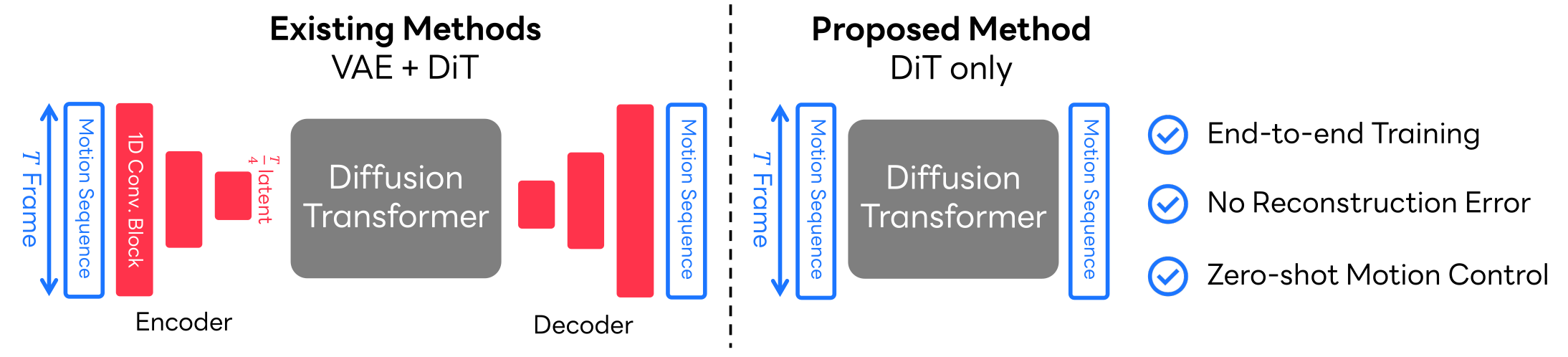
A pipeline connects terrain reconstruction, anatomical retargeting, and muscle-actuated control.
TERRA terrain-aware locomotion overview. Credit: TERRA authors · EPFL. Original image ↗
Human motion datasets often record movement without the terrain that supported it. TERRA addresses that gap by reconstructing task-relevant support geometry from kinematic trajectories, then retargeting and controlling a musculoskeletal body.
Recover the support that explains the pose
A foot rising in space may indicate a stair, a jump, or a recording error. A seated body needs a supporting surface, while a hand may pass through empty space. Motion alone leaves ambiguity about the environment.
TERRA combines terrain priors, estimated contacts, and evidence about free space to infer geometry relevant to the movement. It then retargets that movement with anatomical and contact constraints. The methodology makes terrain reconstruction part of the control pipeline instead of assuming every trajectory happened on flat ground.
Three connected stages
- Recover support geometry using terrain priors, estimated contacts, and free-space evidence.
- Retarget motion with anatomical, tendon-continuity, and contact constraints.
- Train a muscle-actuated policy on the resulting motion–terrain pairs.
The project presents stairs, ramps, individual platforms, seats, beams, and uneven terrain.
Why terrain belongs in the data
A foot trajectory makes more sense when the stair underneath it is represented. A seated pose depends on support. Treating these interactions as motion over flat ground removes evidence needed for physically coherent control.
The authors report training one policy on the 9.4-hour training split of an 11.3-hour locomotion library. Their comparisons evaluate reconstruction, retargeting, and held-out tracking rather than only visual similarity.
Work through a contact gap
Suppose a recorded foot contact is at z = 0.20 metres and the supporting stair surface is at z = 0.18 metres in the same coordinate frame. The vertical gap is two centimetres. Treating that contact as if it belonged on flat ground at z = 0 instead creates a twenty-centimetre gap:
The chart compares these two hypothetical support assumptions. It is not TERRA's measured reconstruction error, and the two-centimetre value is not a recommended contact tolerance. It shows why the environment belongs in the accounting. A foot trajectory and a support surface must be expressed in compatible units and coordinates before their relationship can be evaluated.
A small gap alone does not establish a plausible contact. A foot could slide across a surface, penetrate it at another frame, or occupy an implausible anatomical configuration. A large gap could be correct during flight rather than stance. Contact timing, geometry, and the movement phase determine which residual should be penalized. This is why estimated contacts and negative free-space evidence answer complementary questions about the environment.
Follow the error through all three stages
If the inferred stair is too high, retargeting may compensate with a different knee bend. A controller may then struggle to track the revised motion. The final failure can originate in geometry even though it appears as poor tracking. Conversely, an accurate support surface does not guarantee that the retargeted body can realize the recorded pose under its anatomical and tendon constraints.
Preserve a record at each stage: support reconstruction, retargeted trajectory, and controlled rollout. Use the same reference motion when comparing alternative terrain assumptions. A review that starts only with the final video cannot explain which stage introduced an error. The pipeline is useful because it makes those intermediate relationships inspectable.
The reported 9.4 hours of training data are part of an 11.3-hour library. Dividing them gives approximately 83.2%, but that fraction describes duration, not completion accuracy or generalization. Held-out terrain families and tracking tests still need their own definitions. Keep duration, terrain coverage, and outcome metrics separate so a reader can understand what the training split represents and what the evaluation actually asks the controller to do.
A terrain assumption changes the contact residual
- Support geometry
- Anatomical retargeting
- Muscle-actuated tracking
Focus the graph and use arrow keys, or tap a point, to inspect values. The complete data table is available below.
View data table
| Category | Vertical gap (cm) |
|---|---|
| Stair at 18 cm | 2 |
| Flat ground | 20 |
Review one terrain interaction at a time
Choose a stair, ramp, or seat example and identify the support points. Compare the inferred support with the reference geometry, then inspect the retargeted body. Does a foot rest on the surface it should use? Does a joint take an implausible pose to compensate for the inferred terrain?
Finally, watch the controlled rollout. Accurate reconstruction, plausible retargeting, and successful tracking are three different tests. Passing the first does not imply that the policy completes the motion, and a completed motion does not prove that every anatomical constraint was satisfied.
Keep training coverage visible
The published library includes several terrain families, and the authors describe held-out tracking comparisons. Check which families and motions belong to training and which test generalization. A result on supported terrain should not become a claim of unrestricted locomotion on any environment.
For a reproduction, begin with the repository linked from the project and examine dataset preparation, body configuration, and the evaluation definitions together. Report the terrain and constraint failures alongside completion. We have reviewed the research workflow and demonstrations, not trained the muscle-actuated policy or validated the system for clinical use.